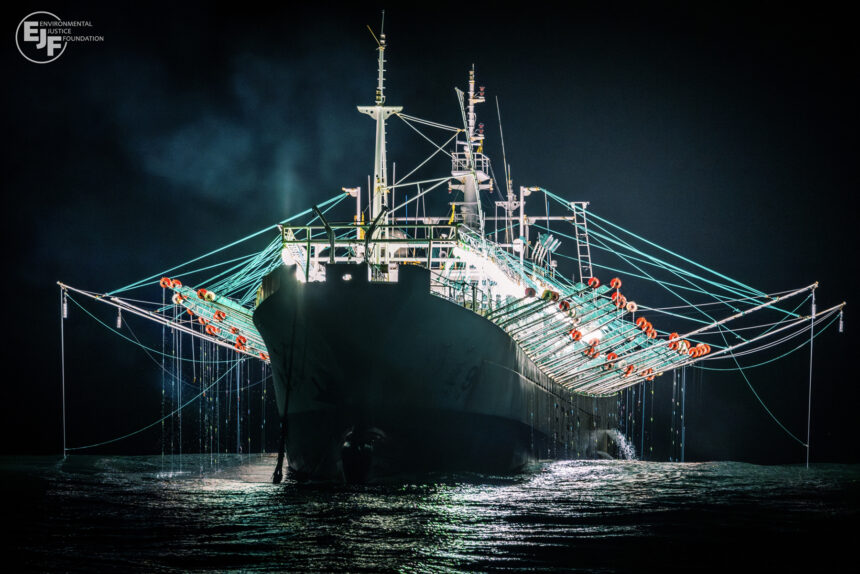
Fifteen governments from Africa, Asia, the Caribbean, Europe, and the Pacific have adopted the Mombasa Declaration at the 11th Our Ocean Conference, committing to accelerate global efforts to improve fisheries transparency and tackle illegal, unreported, and unregulated (IUU) fishing.
The declaration calls on both coastal and flag States to strengthen the collection, publication, and sharing of fisheries-related data, particularly vessel ownership details, licensing information, and fishing activity records. It is designed to close long-standing transparency gaps that have made illegal fishing difficult to detect and prosecute.
It also reinforces global momentum behind the Global Charter for Fisheries Transparency, which outlines a set of practical, low-cost policy actions aimed at improving ocean governance through greater openness and accountability.
Global coalition of signatories
Countries endorsing the declaration include Belgium, Cameroon, Chile, the Dominican Republic, France (representing its overseas territories), Gambia, Ghana, Guinea, Liberia, Panama, Papua New Guinea, Peru, the Republic of the Congo, Somalia, and South Korea.
Following adoption, signatory states are expected to begin implementing the commitments domestically, while a broader campaign is being launched to encourage additional countries to join ahead of the 2027 Our Ocean Conference.
Illegal fishing under global spotlight
Illegal fishing continues to pose a severe threat to marine ecosystems and coastal economies, particularly in developing nations where fisheries support food security and livelihoods.
IUU fishing is estimated to cost the global economy up to $50 billion annually. It also undermines legitimate fishing industries, contributes to declining fish stocks, and is frequently associated with labour abuses, including unsafe working conditions and forced labour.
Weak transparency around vessel tracking and ownership structures has been identified as a key enabler of these activities, limiting the ability of authorities to monitor and enforce regulations effectively.
Commitments to greater accountability
Under the Mombasa Declaration, governments have committed to practical reforms such as modernising vessel registries, improving access to licensing data, and enhancing information-sharing mechanisms across jurisdictions.
These measures aim to strengthen enforcement capacity and support more sustainable management of marine resources, particularly in high-risk fishing zones.
Strong backing from global partners
Ghana’s Minister for Fisheries and Aquaculture, Emelia Arthur, underscored the importance of fisheries to national economies, noting that fish remains a critical source of protein and employment for millions. She described the declaration as a platform for collective international action to strengthen transparency in the sector.
France’s Minister Delegate for the Sea and Fishery, Catherine Chabaud, said the initiative highlights the need for stronger cooperation between nations, stressing that transparency is essential to effectively combat illegal fishing.
The Coalition for Fisheries Transparency, which supported the development of the declaration, said the agreement reflects growing global recognition of the need for accessible and reliable fisheries data.
Industry and advocacy voices also welcomed the move. Oceana, the Environmental Justice Foundation, Global Fishing Watch, and Bloomberg Philanthropies all emphasized that greater transparency will be critical in exposing illegal practices, improving governance, and protecting ocean ecosystems.
The Mombasa Declaration is expected to drive renewed international action on fisheries governance, with participating countries now moving into an implementation phase and seeking wider global adoption in the coming years.