
Kenya’s Prime Cabinet Secretary urges reforms at the United Nations and calls for stronger accountability in public institutions.
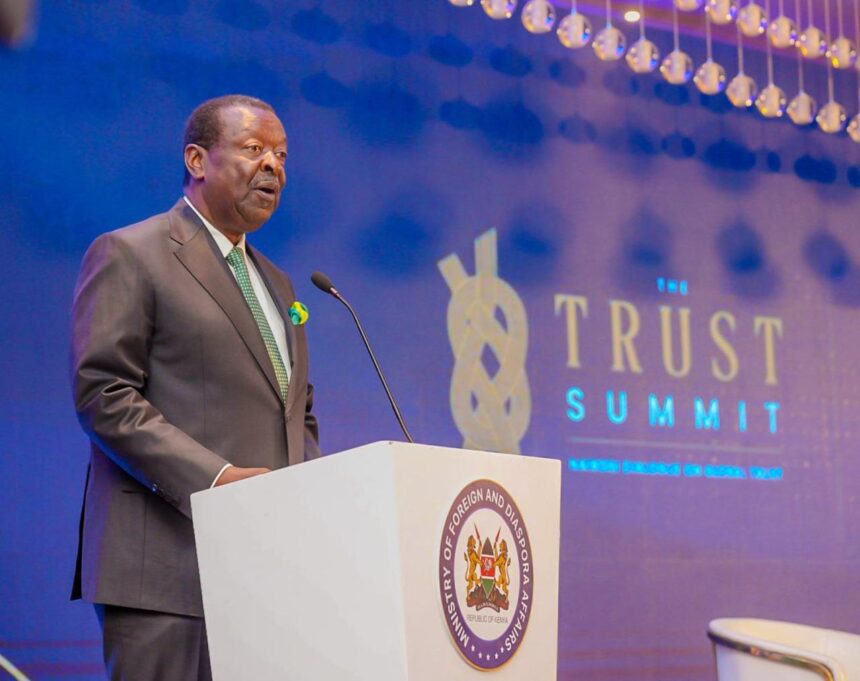
Kenya’s Prime Cabinet Secretary Musalia Mudavadi has called for reforms to international institutions, arguing that Africa’s limited representation in global decision-making structures undermines their legitimacy and public confidence.
Speaking at the Global Trust Summit in Nairobi, Mudavadi said international institutions must demonstrate fairness, representation and the ability to deliver results if they are to retain the confidence of citizens and governments.
He singled out Africa’s absence of a permanent seat on the United Nations Security Council, saying the continent should have a direct role in decisions affecting its security and future.
An arrangement that gives Africa permanent representation on the Council, consistent with the African Union’s Common African Position, would strengthen confidence in the United Nations among African citizens, he said.
Mudavadi’s remarks came amid wider discussions on the relationship between public trust, institutional accountability and international cooperation. He warned that declining confidence in institutions threatened economic prosperity, social stability and the capacity of governments to respond to shared challenges.
“When a society loses the trust of its people, it risks losing the very foundation upon which its institutions, prosperity and common future depend,” he said.
He called for public institutions to demonstrate integrity, remain open to scrutiny and ensure that their decisions produce tangible benefits. Trust, he argued, should not be treated as a substitute for accountability.
Citing an Afrobarometer working paper drawing on survey data from 37 African countries, Mudavadi said greater trust in presidents and ruling parties was associated with weaker public support for accountability mechanisms, including parliamentary oversight, media scrutiny and citizens’ ability to hold governments accountable.
He also called on the summit to establish a practical framework for rebuilding trust, supported by clear commitments, a coalition of implementing actors and a credible mechanism for tracking progress.
The economic implications of trust also featured in his address. Mudavadi described it as an essential foundation for commercial relationships, noting that legal safeguards and contracts could not entirely replace integrity and a reputation for keeping one’s word.
The summit also examined regional cooperation through remarks by Tanzania’s Deputy Minister for Foreign Affairs and East African Cooperation, James Millya, who reported progress in removing trade barriers between Kenya and Tanzania.
Of 68 identified non-tariff barriers, 54 had been resolved, leaving 14 outstanding. Millya said agreements between the two countries needed to translate into faster border clearance, fewer repeated inspections and more effective resolution of traders’ complaints.
The Global Trust Summit, held in Nairobi from October 21 to 23, brings together public-sector leaders and other stakeholders to examine how trust can strengthen governance, resilient societies, inclusive economies and international cooperation.
Mudavadi said Nairobi should be remembered not merely as the venue for discussions on trust, but as a place where leaders strengthened their commitment to more accountable institutions.