

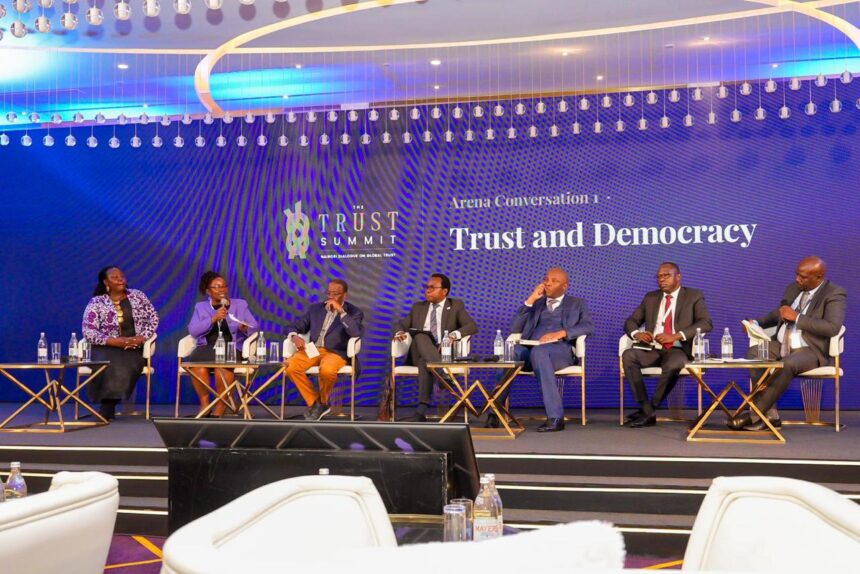
Kenyan leaders, regulators and civil society representatives have called for greater accountability, responsive public institutions and meaningful citizen participation as the Global Trust Summit in Nairobi examines ways to rebuild confidence in governance and international cooperation.
Speaking during the October 21–23 meeting, participants said public institutions must earn citizens’ confidence through credible information, timely responses to complaints, fulfilled promises and demonstrable improvements in service delivery.
“This is not a summit of convenience. It’s a summit of necessity,” said Dr Abraham Korir Sing’Oei, Principal Secretary for Foreign Affairs, pointing to the urgency of rebuilding trust amid inequality, geopolitical tensions and declining confidence in institutions.
The summit, held under the theme “Weaving Trust: Binding Strands for a Stronger Global Order,” has brought together government officials, multilateral institutions, business leaders, academics, civil society representatives and young people to discuss practical measures for restoring confidence in public and private institutions.
A key message emerging from the opening discussions was that transparency alone cannot restore trust unless information leads to corrective action.
Auditor-General Nancy Gathungu said credible and useful information must be accompanied by action across the accountability chain, including follow-up on audit findings and institutional oversight.
Dr Priscilla, Director of the Communications Authority of Kenya, argued that accountability required cooperation among institutions, warning that unresolved complaints could deepen public frustration.
“Trust does not stop with complaints. It stops when the complaint has been resolved,” she said.
Dorothy Jemator Kimengech, Vice-Chairperson of the Commission on Administrative Justice, said citizens needed a clearer understanding of public institutions, their responsibilities, structures and projects to assess their performance.
Kenya Bureau of Standards Chief Executive Esther Ngari observed that the public often notices standards and regulatory systems most when they fail.
“When standards work, no one recognizes, but when they fail, that is when questions arise,” she said.
Felix Koskei, Chief of Staff and Head of the Public Service, said public institutions must demonstrate the standards they expect others to follow.
“A regulator that demands compliance from others must be an example of compliance,” he said.
Public participation also featured prominently, with speakers arguing that democratic accountability should continue beyond elections.
Government Spokesperson Charles Owino said democratic power ultimately rests with citizens, while Duncan Ojwang’, chairperson of the Independent Policing Oversight Authority, cautioned against public participation being dominated by the loudest voices.
“Let us not turn public participation to the noisiest, let it be universal,” he said.
Transparency International Kenya Executive Director Sheila Masinde said public participation should be respected as a democratic right rather than treated as an inconvenience.
Mzalendo Trust Executive Director Caroline Gaita added that consultations without feedback risk becoming symbolic.
“Participation without a feedback loop is not engagement; it’s attendance,” she said.
The summit is also examining trust in business, financial institutions and international governance, including Africa’s limited representation in global decision-making.
Africa, with 54 countries and more than 1.4 billion people, does not have a permanent seat on the United Nations Security Council.
Organisers are seeking to translate the discussions into a proposed Nairobi Call to Action on Global Trust, intended to promote evidence-based approaches, stronger accountability and commitments that can be monitored after the summit.
Awel Uwihanganye, Chief Executive of The Trust Summit, urged Africans to strengthen confidence in their institutions and capabilities.
“Let us trust one another until we are given a reason not to,” he said.
Senate Speaker Amason Jeffah Kingi described trust as “a belief that my legitimate expectations will be met within a reasonable time.”
As the meeting continues through October 23, participants face the challenge of converting their proposals into measurable improvements in governance, public services, economic opportunity and international cooperation.